
When I was thinking about what my first piece of writing for Beyond Linear should be, I kept coming back to the same feeling.
There is already so much conversation around ADHD. So much advice. So many systems, frameworks, and hacks. And the more I thought about it, the more I wanted to begin with something different. Not a preamble about the business. Not a credentials piece. Something that might actually be useful today — to someone sitting with the same tension I recognise from my own life.
So I want to tell you about the Brag Bag.
The problem it is solving
If you have an ADHD neurotype, there is a reasonable chance that your relationship with your own progress is complicated.
Not because you lack self-awareness. Often the opposite. ADHD comes with a particularly active inner critic — a voice that has usually had years of material to work with. Late-diagnosed adults have often spent decades being told, implicitly or explicitly, that they are not quite meeting expectations. Too much in some rooms. Not enough in others. Capable of extraordinary things in certain conditions and apparently incapable of basic ones in others.
The result is a self-narrative that has been built on the wrong evidence.
Add to this something specific about ADHD neurology: the working memory challenges that make it genuinely harder to hold recent positive information in mind. The negativity bias that is amplified in many ADHD brains. The emotional intensity that means criticism tends to land harder and stay longer than praise. And you start to understand why progress — real, demonstrable, evidenced progress — can feel so hard to hold onto.
You have a hard week and you forget the strong month that preceded it. You receive critical feedback and it temporarily erases the ten pieces of positive feedback that came before it. You struggle with something that feels like it should be simple, and it activates a story about your capability that a calmer, more accurate part of you knows is not true.
Where the idea came from
The concept of an evidence bank is not new in coaching. It is the idea of building a record — a deliberately maintained collection of proof that contradicts the inner critic's most persistent arguments. Proof of capability. Proof of progress. Proof of impact.
As an investigator by trade, this framing made immediate sense to me. Evidence is specific. It is concrete. It is harder to argue with than a feeling or a general impression. When the critic says "you're not good enough at this," an evidence bank asks: what does the record actually show?
But here is what I noticed in my own practice: the word "bank" was doing something unhelpful. Banks are formal. They feel like admin. They are somewhere you deposit things dutifully but never actually visit unless you have to.
That was not what I wanted this to be. I wanted something I would return to voluntarily. Something that felt warm and personal rather than clinical. Something that matched the actual human experience of collecting these small pieces of proof — which is, when you allow yourself to do it honestly, something approaching joy.
So the evidence bank became the Brag Bag.
What actually goes in it
The name matters because it sets the tone. A Brag Bag is allowed to contain things that feel small. It is allowed to contain things you would never say out loud in a meeting. It is a private, honest record of things that went well — not a curated highlight reel for external consumption.
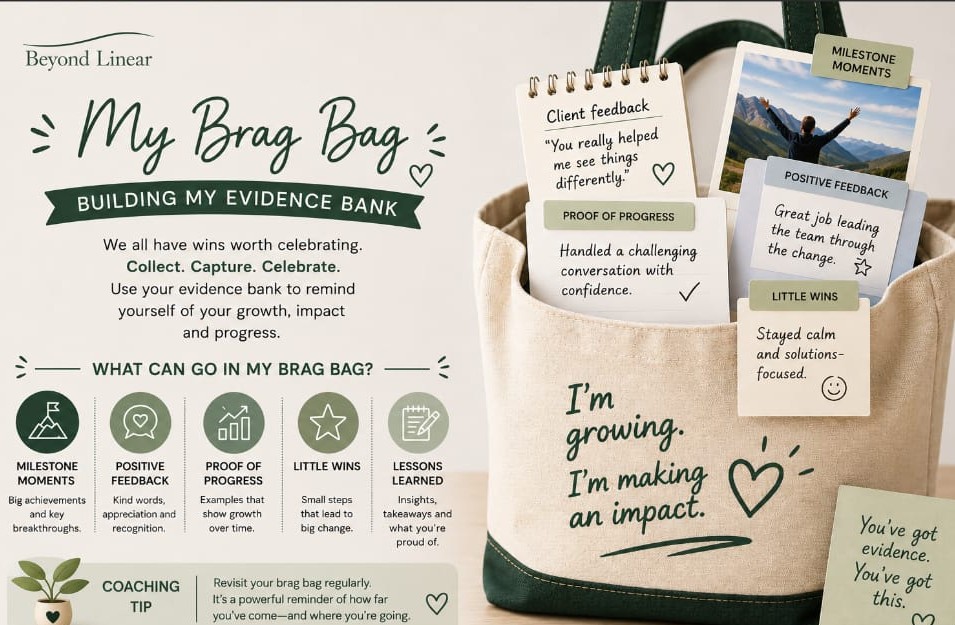
In practice, it tends to fill with five kinds of things:
A note on what counts
There is a tendency, particularly for people with a harsh inner critic, to dismiss entries before they even make it into the bag. "That's not impressive enough." "Anyone could have done that." "That doesn't count." This is the critic doing what it does. The rule is simple: if it felt like something, it goes in. The Brag Bag is not a performance review. It is a record of your actual lived experience of making progress. All of it counts.
Why it works — and why format matters
The Brag Bag is not magic. It is a habit — and like all habits, its value is proportional to how consistently you return to it.
This is where format genuinely matters. If your evidence bank lives in a spreadsheet that requires opening an app, finding a file, and remembering a login, you will not use it on the hard days. On the hard days, the friction needs to be as low as possible.
Some people keep a physical notebook specifically for this purpose. Some use a notes app on their phone. Some have a folder in their email where they move positive messages as they arrive, so they are already stored before the need arises. Some use a jar and actual pieces of paper — something tactile that makes the accumulation visible.
The format matters less than the answer to this question: will you actually open this when you are struggling?
If the honest answer is no, the format needs to change.
How to start
You do not need to do this retrospectively. You do not need to trawl back through years of memories and reconstruct a complete record of your achievements. That is not what this is.
You start now, with what is true today. Then you add to it when something happens — when feedback arrives, when you handle something well, when you notice progress, when you do the small thing that only you know was not small at all.
Revisit it regularly. Not just when you are struggling, though especially then. Read it on a Monday morning before a difficult week. Open it before a performance review. Look at it when the critic is particularly loud and specific and you need something concrete to push back with.
The Brag Bag works because it is honest, specific, and yours. It is not a motivational poster. It is not a list of affirmations about who you want to be. It is a record of who you already are — collected carefully, over time, by someone paying attention.
One question to start
You do not need anything elaborate to begin. You need one entry.
So here is the question I ask every client when we first build theirs — and the question I am asking you now:
What is one win your brain might be overlooking right now?
It does not have to be impressive. It does not have to be recent. It just has to be true.
Write it down somewhere. That is your first entry. You have started.
If any of this has felt familiar — the struggling to hold onto progress, the critic that is louder than the evidence — a conversation costs nothing.