Thought piece
Square Pegs and Square Holes
Are we getting the best out of people, or expecting everyone to fit the same mould?

Remember those wooden shape-sorter toys?
The ones where you had to fit the square through the square hole, the circle through the circle and the triangle through the triangle. Simple enough, once you’d worked out which shape went where.
But imagine trying to force the square through the circle hole. You could push harder, try a different angle or keep telling the square it needed to try harder. You might get frustrated with it, too.
At some point, though, you might stop and wonder whether the problem is the square — or the hole.
How often do we expect everyone to fit the way things have always been done, rather than asking whether there’s a better way to make the work fit the people doing it?
We’re not all built the same
We all have different strengths, ways of thinking, preferences and things we find difficult. That’s hardly a revolutionary idea. Yet in the workplace, we can still act as though there’s one right way to work, communicate, learn or perform.
For example, someone whose strengths lie in sales might be brilliant at building relationships, reading a room and thinking on their feet. That doesn’t mean they’d naturally thrive in a role that requires long periods of detailed technical analysis. We wouldn’t necessarily put them in IT and then criticise them for not approaching the job like the person who’s best suited to it.
That doesn’t mean people can’t learn new skills or stretch themselves. It means we should pay attention to what people bring, what the role actually needs and what conditions help them do their best work.
With ADHD, strengths and difficulties can sit alongside each other. Someone might be creative, curious and excellent in a crisis, but struggle with task initiation, time awareness or processing lots of verbal information at once. The strengths don’t cancel out the difficulties, and the difficulties don’t erase the strengths.
And this isn’t just about ADHD or neurodivergence. None of us is built exactly the same. The more we understand that, the better chance we have of helping people contribute in ways that work for them and for the organisation.
Ask, don’t assume
No two people will need exactly the same support, even if they share a diagnosis or disability. Their experiences, preferences, strengths and challenges can be very different. A label might tell us something, but it doesn’t tell us everything about a person or what they need in a particular situation.
My cousin has cerebral palsy. I remember being at an event where we explained that she was disabled, and the response was to offer her a wheelchair. It struck me as a narrow way of looking at things — as though the disability had been recognised and a wheelchair was the only solution that came to mind.
The intention may have been to help, but nobody had first asked what she actually needed.
It’s a reminder that we need to ask, not assume. The same applies at work. Rather than deciding what someone needs based on a diagnosis, ask what’s getting in the way and what might help. And be prepared for the answer to be different from what you expected.
Sometimes the answer will be a formal adjustment. Sometimes it might be a small change in how information is shared, how a meeting is run or how a task is organised. We won’t know what’s useful until we have the conversation.
What can this look like in practice?
I think we can sometimes overcomplicate support. We assume it needs expensive software, costly programmes, significant changes or a complete overhaul of the way we work. Sometimes it does take investment and careful planning. But sometimes a few relatively simple changes can make a real difference.
-
Make information easier to use. Written instructions in clear bullet points can be easier to refer back to than a long verbal explanation.
-
Allow time to process. Some people need a little time after a meeting to think through feedback or formulate a response. Not everyone processes information at the same speed.
-
Explain the purpose of the meeting. One of my cardinal sins is being invited to a meeting with no explanation of what it’s about. If you’re prone to uncertainty or anxiety, your brain can fill in the gaps. You might have already mentally sacked yourself and worked out what you’re going to do next — before the meeting has even happened.
-
Be open to flexibility where the role allows it. I once had someone who really struggled with mornings because of their neurodivergence. They asked to work a later shift — either 10–6 or 12–8. It turned out to be a win-win: mornings were difficult for them, while others in the team didn’t particularly want to work late.
-
Consider coaching support. Coaching can give someone space to understand how they work best, recognise strengths, develop strategies and work through challenges. It can also help turn a vague sense of “I’m struggling” into a clearer conversation about what might help.
-
Check whether the solution is working. Agreeing to something is not the same as knowing it’s effective. Check in with the person and, where relevant, the team. If it isn’t helping or the practicalities aren’t working, review it and see what needs to change.
The individual, the team and the business
That shift example also shows why we need to look at the bigger picture. What is the person asking for? Why might they need it? What does the role actually require? And how would the arrangement affect the rest of the team and what the business is trying to achieve?
Supporting someone doesn’t mean the needs of the team or the business stop mattering. Businesses have customers to serve, work to deliver, budgets to manage and operational risks to consider. Equally, starting and ending with “that wouldn’t work for the business” can mean we miss an option that might work perfectly well if we looked at it differently.
Not every request will be possible or reasonable for a particular role. Sometimes there will be genuine constraints; sometimes we may need to explore a compromise or an alternative. The important thing is to understand the request, consider the individual circumstances and the practical implications, and have a proper conversation rather than automatically saying yes or no.
In my compliance career, I’ve always made a distinction between technical compliance and effective compliance. You can tick every box and still miss the point of what a law or regulation is there to achieve. What matters is understanding the intent, managing the actual risk and making sure what you’re doing is effective in practice.
I think there’s a parallel here. We can have policies, processes and adjustment procedures in place and still fail to create an environment where people can do their best work. The question isn’t simply whether we’ve followed the process. It’s whether we’ve understood the need, considered the risks and found an approach that works in practice.
That means bringing different perspectives into the conversation. The individual understands their own experience. The manager understands the work and operational requirements. HR can help navigate policies and legal obligations. We need those perspectives working together, rather than looking at the question through only one lens.
And where a request involves a legal duty to consider reasonable adjustments, that duty needs proper individual consideration. A request that feels inconvenient isn’t automatically one that cannot reasonably be accommodated.
Back to the shape sorter
I’m not suggesting that every role can be redesigned around every individual, or that there’s always a simple answer. Sometimes the shape and the hole really don’t match, and we have to be honest about that.
But before we decide someone doesn’t fit, it’s worth asking whether we’ve understood what they bring, what the role needs and whether there’s another way to make things work.
We wouldn’t keep forcing a square through a circular hole and blame the square for not fitting.
So why do we sometimes do the equivalent with people?
Perhaps the starting point isn’t to ask how we get everyone to fit the same mould. It’s to get curious about the people in front of us — and work out what helps them, their team and the business succeed.

A note on my perspective
I’ve spent over 20 years working in a corporate environment, including around 14 years with people management responsibilities. I understand the challenges of supporting people, helping them realise their potential, delivering for the business and managing budgets. These things don’t always sit neatly alongside one another, and finding the right balance isn’t always straightforward.
What I share here comes from my professional experience, my own lived experience and my ongoing learning and study.
These are my personal views and reflections, rather than the views of any organisation I’ve worked for.
Let’s create the conditions for people to thrive
We don’t need to make every hole fit every shape. But we should take the time to understand the shape we’re working with, consider whether the hole can be different, and be open to finding another way when needed.
If this resonates with you, whether personally or as someone supporting others, you can find out more about how Beyond Linear supports individuals with ADHD through coaching at beyondlinear.co.uk.
Want to keep this or share it with your team? Download the one-page summary.
Download one-pager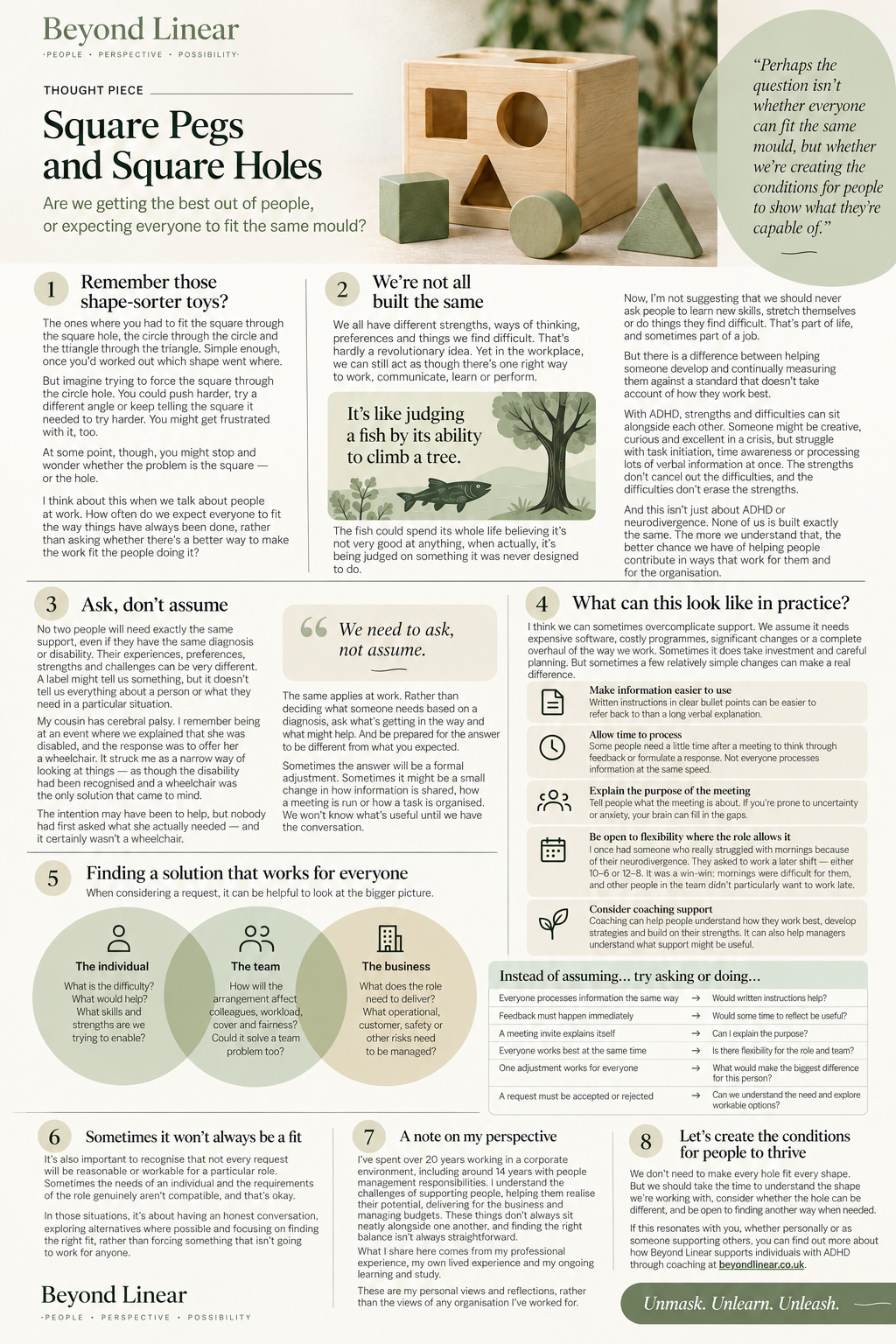
Unmask. Unlearn. Unleash.