Thought piece
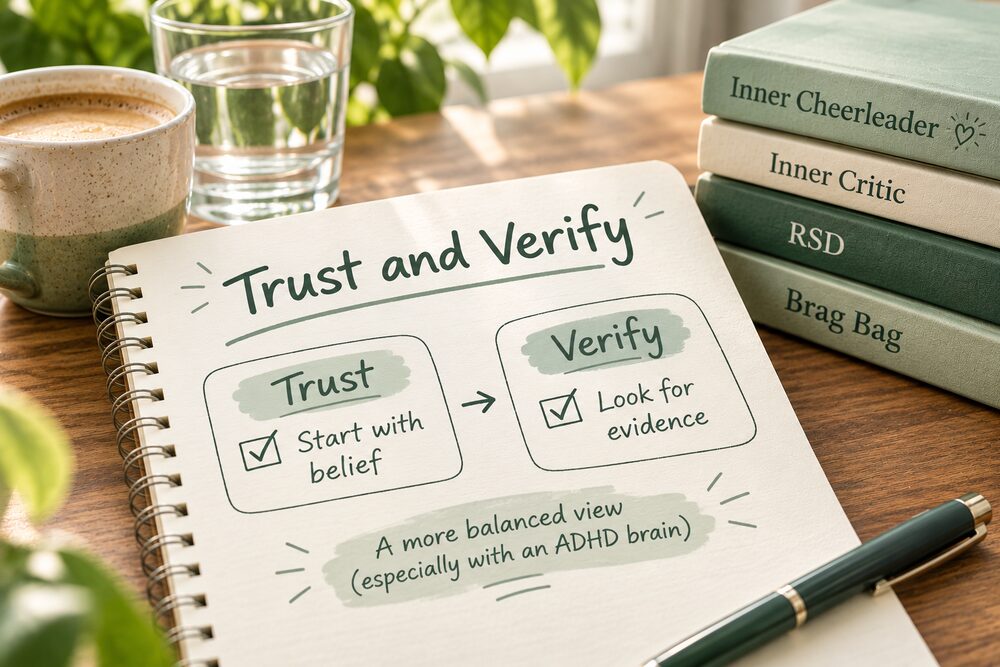
Trust and Verify
What if you challenged your self-doubt with the same compassion you offer to others?
A different way of looking at self-doubt, and learning to become your own Inner Cheerleader.
Introduction
When I started my ADHD coach training, I felt out of my depth. It was a very different area for me, and I worried that the rest of the cohort had more experience and knowledge than I did. What I found was a lot of encouragement, and the chance to reframe and reuse experience I already had from my career in financial crime prevention and compliance. This piece looks at one example.
In compliance, “trust but verify” is a familiar principle. We might accept that what someone has told us is accurate, but we don’t take it at face value. We look for evidence, test it, and make sure it stands up to scrutiny. I’ve changed one word. “And” rather than “but” feels fairer: trust and verification working together, rather than one grudgingly allowed by the other.
I think the same principle applies to how we treat ourselves. Many of us, and I include myself, find it easier to believe the negative than the positive. A compliment gets questioned. An achievement gets downplayed. Someone tells us they value our work and our brain produces a dozen reasons why they might not mean it. Often the Inner Critic has reached its verdict before we’ve finished processing what was said.
What strikes me is that the critic’s claims rarely get checked. They arrive as facts. Trust and Verify asks us to treat them like any other claim: where is the evidence?
Here are five places where I think it helps.
1. Trust that you can do your job
You have a role, responsibilities and a little voice asking whether you’re really good enough to be doing it. Maybe you compare yourself with colleagues, or wait for someone to realise you’re not as capable as they thought.
Start by accepting that you are capable of the role. You don’t need to feel confident every day, or to know everything. Then check the record: promotions, pay rises, extra responsibility, positive feedback, things you delivered when you weren’t sure you could. Constructive feedback counts too. Someone investing time in your development is often a sign they see potential, even if it wasn’t delivered well and you don’t agree with all of it.
This is what the Brag Bag is for. It keeps the evidence somewhere your memory doesn’t have to.
2. Trust that people mean what they say
This can be hard if you experience Rejection Sensitive Dysphoria (RSD). Someone tells you that you’ve done a good job, and your brain starts. Did they really mean it? Were they just being polite? Was there something in their tone?
Start by accepting that they’ve told you how they genuinely feel. Then look at the relationship. What is your experience of this person? Do their actions match their words? If someone has consistently shown you that they value you, is it fair to dismiss what they say because your brain looked for and came up with an alternative explanation?
This isn’t about ignoring red flags or believing everyone without question. It’s about not letting the fear of rejection become the only evidence you consider. Sometimes people really do mean the nice things they say.
3. Trust that a mistake doesn’t define you
One small error can quickly become “evidence” that we’re disorganised, unreliable or not good enough. The Inner Critic can turn a single event into a verdict on our whole capability.
Check what actually happened. Was it one mistake, or a pattern that needs attention? Were the expectations clear? Have you handled something similar before? And what would you say to a colleague who made exactly the same mistake? We tend to be far more understanding of other people than of ourselves.
A mistake is something you did. It isn’t necessarily a reflection of who you are.
4. Trust that you are making progress, even when it doesn’t feel like it
With ADHD, progress rarely looks linear. A productive week can be followed by one where everything feels harder, and progress in one area can sit alongside struggle in another. That doesn’t mean you’re back at the beginning.
Look back. What can you do now that you couldn’t six months ago? What have you learned, finished or tried, even if it didn’t work? Small wins count here too. Sometimes the evidence is simply that something which used to feel impossible now feels manageable.
5. Trust that you don’t have to get everything right first time
How often do we delay starting because we don’t feel ready? We want the perfect plan, and certainty that it will work, before we take the first step. The Inner Critic is persuasive here: do more research, wait until you feel more confident. Sometimes, without realising it, preparation becomes a way of avoiding the chance of getting it wrong.
What if we treated an unsuccessful attempt as information rather than failure? I try to do this myself. Look at your own history. How many things have you learned by doing them? When did you work it out, ask for help, adapt or find another way? Each attempt tells you something you didn’t know before.
Confidence doesn’t always come before action. Sometimes it comes from seeing what you can do once you’ve acted.
Finding your own cheerleader
I talk a lot about the Inner Critic, the voice that’s quick to point out what we’ve got wrong and why we’re probably not good enough. But there’s another voice: the one that reminds us what we’re capable of and offers a bit of encouragement when we need it. I call it our Inner Cheerleader.
There’s a song by OMI called “Cheerleader”, built around having someone in your corner. It got me thinking: what if that person didn’t have to be someone else? Not someone who tells us we’re brilliant at everything, but someone who helps us see the whole picture, including what we’d otherwise overlook.
This isn’t about forcing positive thinking. It’s about a fairer assessment.
What if the cheerleader you’ve been looking for could be you?
The Inner Critic and the Inner Cheerleader
A quick comparison to make the distinction easier to recognise.
The Inner Critic
- Speed
- Reaches a conclusion quickly
- Evidence
- A feeling, an assumption or one experience
- Scope
- Whatever supports the negative view
- Tone
- Certain, treats its view as fact
The Inner Cheerleader
- Speed
- Pauses and asks questions
- Evidence
- What the record actually shows
- Scope
- The whole picture, good and difficult
- Tone
- Honest, doesn’t pretend difficulties don’t exist
When the critic reaches a verdict, try pausing on these:
- What am I assuming here?
- What evidence do I actually have?
- Am I considering all the evidence, or only the parts that support my negative view?
- What would I say to a friend in this situation?
- Is there another explanation I haven’t considered?
Trust and Verify: a quick reference
| Trust that… | Verify by looking at… |
|---|---|
| You can do your job | Promotions, feedback, what you’ve delivered, what’s in your Brag Bag |
| People mean what they say | The relationship, their actions and their track record |
| A mistake doesn’t define you | The wider picture: one-off or pattern, the circumstances, how you’ve handled similar situations |
| You are making progress | Where you were six months ago, and what you’ve learned, finished or tried since |
| You can take the next step before you feel ready | Times you’ve learned by doing, adapted or asked for help |
Bringing it back to Trust and Verify
In financial crime prevention, we wouldn’t normally make a decision on assumption alone. We would look for supporting evidence, consider the wider context and reach a conclusion based on what we know. Perhaps we can give ourselves the same consideration.
Your brain might not always make this easy. But the more often you practise looking for evidence that challenges your Inner Critic, the more chance your Inner Cheerleader has to be heard.
You don’t have to convince yourself that everything is fine. You just have to give yourself the chance to see the whole picture.
Perhaps the biggest shift is learning not to accept our Inner Critic’s version of events without question. We deserve the same fair consideration that we would give to anyone else.
One question to start
What is one thing your Inner Critic has told you this week that you haven’t actually checked?
A note on my perspective
My reflections come from my professional experience, my own lived experience and my ongoing learning in ADHD coaching. These are personal views, rather than the views of any organisation I’ve worked for.
A note on support
This piece is a prompt for reflection, not a substitute for clinical support. If self-doubt feels overwhelming or won’t ease, your GP or a qualified mental health professional is a sensible next step.
Want a quick reminder to keep to hand? Download the Trust and Verify one-page reference guide (PDF), a companion to this article.
Download one-pagerWant to explore this further?
If this resonates with you, whether personally or as someone supporting others, you can find out more about how Beyond Linear supports individuals with ADHD through coaching at beyondlinear.co.uk.
Unmask. Unlearn. Unleash.